When exploring home financing options as a veteran, one question often comes up: do VA loans have mortgage insurance? Many people assume that every home loan requires private mortgage insurance (PMI), but VA loans are a unique benefit offered to service members, veterans, and eligible surviving spouses. Understanding the ins and outs of VA loans, including how mortgage insurance applies—or doesn’t—can save you thousands and help you make informed decisions.
In this article, we’ll break down VA loans, mortgage insurance requirements, fees, and common misconceptions, all from an SEO-informed perspective to give you clarity and value.
What Is a VA Loan?
A VA loan is a mortgage loan program established by the U.S. Department of Veterans Affairs (VA) to help eligible veterans, active-duty service members, and surviving spouses buy, build, or refinance a home. These loans are designed to make homeownership more accessible and affordable by providing:
- No down payment requirement in most cases
- Competitive interest rates
- Limited closing costs
- No private mortgage insurance (PMI)
Many potential homeowners wonder, do VA loans have mortgage insurance, since PMI is standard for most conventional loans with less than 20% down. The answer is nuanced, and we’ll cover it in detail.
Do VA Loans Have Mortgage Insurance?
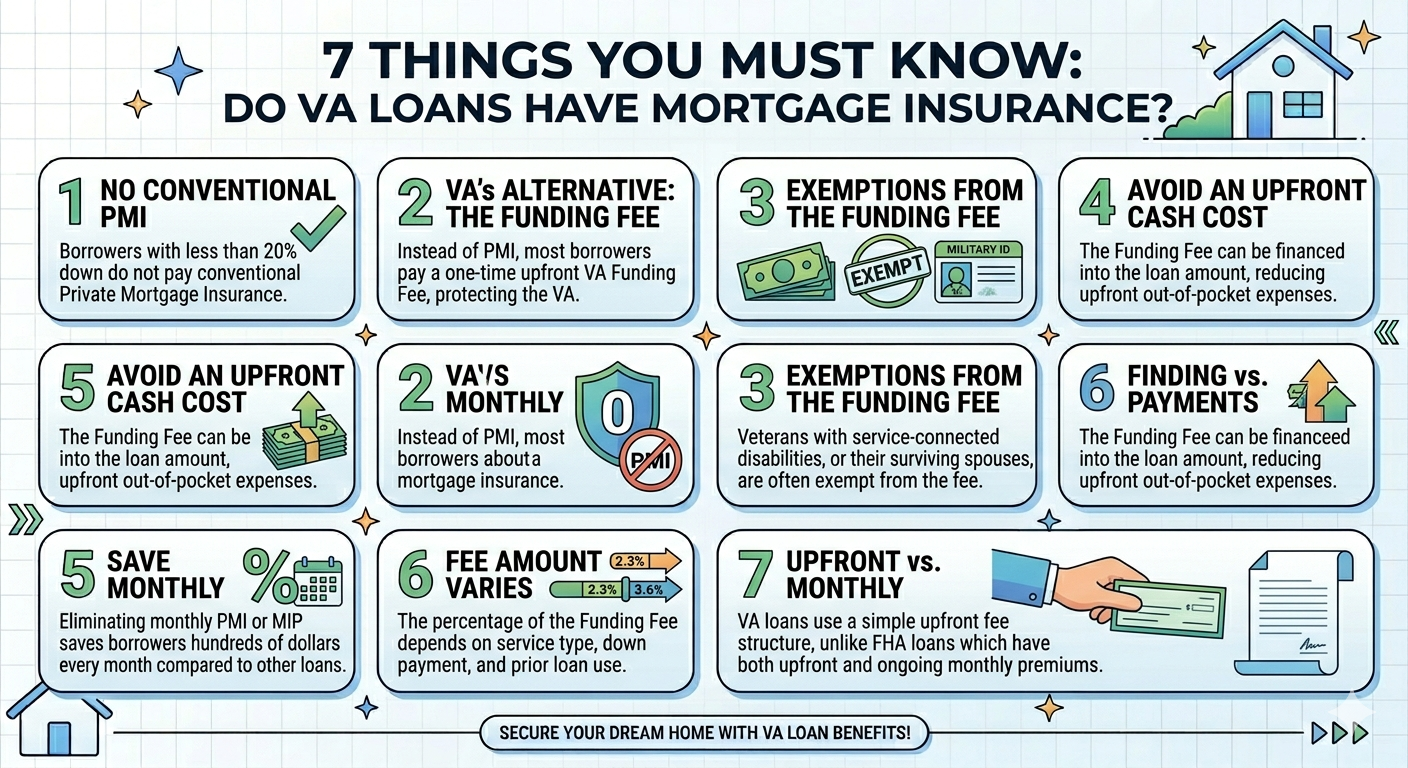
The short answer is no, VA loans do not have traditional mortgage insurance. Unlike conventional or FHA loans, VA loans eliminate the need for monthly mortgage insurance premiums. Instead, they require a VA funding fee, which functions differently from mortgage insurance but may seem similar to some borrowers.
VA Funding Fee vs. Mortgage Insurance
| Feature | VA Loans | Conventional Loans with PMI |
|---|---|---|
| Insurance Requirement | No monthly mortgage insurance | Monthly PMI required if down payment <20% |
| Upfront Cost | VA funding fee (one-time) | Typically 1–2% upfront PMI fee possible |
| Purpose | Supports the VA loan program | Protects the lender from default risk |
| Refundable | Yes, for disabled veterans | No |
| Payment Structure | Paid upfront or financed | Paid monthly as part of mortgage |
The table above highlights the key difference. VA loans do not burden you with ongoing mortgage insurance. Instead, the VA funding fee is a one-time cost intended to sustain the VA loan program.
Understanding the VA Funding Fee
Even though VA loans do not require mortgage insurance, most borrowers pay the VA funding fee. Its purpose is not to protect the lender but to offset the costs of the VA loan program and ensure its sustainability for future veterans.
VA Funding Fee Rates
The funding fee varies based on whether it’s your first VA loan, your down payment, and whether you are active-duty, a veteran, or a surviving spouse.
| Borrower Type | First-Time Use | Subsequent Use | Down Payment Options | Fee (%) |
|---|---|---|---|---|
| Veteran or Active Duty | No down payment | No down payment | 0% | 2.15% |
| Veteran or Active Duty | No down payment | No down payment | 5–10% down | 1.25% |
| Veteran or Active Duty | First-time use | With down payment | 5–10% | 1.25% |
| Disabled Veteran | Any | Any | Any | 0% |
| Surviving Spouse | Any | Any | Any | 2.3% |
Important Note: The funding fee can be financed into your mortgage, which reduces the upfront cash needed at closing.
Benefits of No Monthly Mortgage Insurance
Since VA loans do not require PMI, borrowers enjoy several financial advantages:
- Lower monthly payments – PMI often adds hundreds to your monthly mortgage. VA loans eliminate this.
- Increased home affordability – Without PMI, you can qualify for a larger home or reduce your debt-to-income ratio.
- One-time funding fee – The VA funding fee is typically smaller than PMI over time, especially if financed.
- Veteran-friendly protections – Disabled veterans and surviving spouses may be exempt from the funding fee entirely.
Comparing VA Loans and FHA Loans
FHA loans are another popular government-backed option, but they differ from VA loans in terms of mortgage insurance requirements.
| Feature | VA Loan | FHA Loan |
|---|---|---|
| Down Payment | 0% | 3.5% minimum |
| Monthly Mortgage Insurance | No | Yes (MIP) |
| Upfront Fee | VA funding fee | Upfront MIP (1.75% of loan) |
| Credit Requirements | Flexible | Generally moderate |
| Eligibility | Veterans, service members, surviving spouses | Any qualified borrower |
As seen above, VA loans clearly stand out for their lack of monthly mortgage insurance, which answers the question: do VA loans have mortgage insurance? They do not, which can be a major benefit for eligible buyers.
How to Minimize the VA Funding Fee
Even though VA loans are free of traditional mortgage insurance, the funding fee is still a consideration. Here are ways to manage or reduce it:
- Make a down payment – Even 5–10% can lower your fee.
- Check exemption eligibility – Disabled veterans and surviving spouses may qualify for a waiver.
- Finance the fee – Most lenders allow you to include it in your loan amount.
- Reuse VA benefit strategically – The fee decreases on subsequent use if you make a down payment.
VA Loan Eligibility
Before asking, do VA loans have mortgage insurance, it’s important to confirm eligibility. Not everyone qualifies. Basic eligibility requirements include:
- Service Requirements: Minimum active-duty service or service in the National Guard or Reserves.
- Character of Service: Honorable discharge is typically required.
- Surviving Spouse: Must meet specific criteria if the veteran passed away.
- Certificate of Eligibility (COE): Required to prove you qualify for a VA loan.
Your lender will verify these details and help you navigate the funding fee as well.
Common Misconceptions About VA Loans
Many borrowers are confused about VA loans because they differ from conventional mortgages. Some common misconceptions include:
- “VA loans have no fees at all.” – False. There is a VA funding fee, but no monthly mortgage insurance.
- “You must make a down payment.” – False. Most VA loans allow 0% down.
- “Only veterans qualify.” – False. Active-duty service members and certain surviving spouses are also eligible.
- “VA loans are more expensive.” – False. Interest rates and long-term costs are often lower than conventional loans due to no PMI.
Do VA Loans Require Mortgage Insurance for Refinances?
For VA interest rate reduction refinance loans (IRRRLs), also called VA streamline refinances, the answer remains no monthly mortgage insurance. However:
- A VA funding fee may apply for cash-out refinances (not IRRRLs).
- Refinances keep your mortgage insurance costs low compared to FHA or conventional refinancing.
Advantages Beyond No Mortgage Insurance
VA loans offer other perks beyond not requiring PMI:
- No prepayment penalties – You can pay off your loan early without fees.
- Assumable loans – VA loans can be transferred to another eligible borrower.
- Flexible credit requirements – Often easier to qualify than conventional loans.
- Competitive rates – Usually lower than conventional rates, partly due to reduced lender risk.
These features make VA loans ideal for eligible veterans, even if you consider the funding fee as a cost.
VA Loan Limits and How They Affect Mortgage Insurance
Unlike conventional loans, VA loans do not have a strict loan limit when you have full entitlement. This means your maximum loan amount isn’t limited, although lenders may impose limits based on income or property value. Since there is no monthly mortgage insurance, high-balance loans remain manageable compared to conventional financing.
How VA Loans Affect Home Buying Decisions
The question do VA loans have mortgage insurance often influences your choice between loan programs. Without monthly PMI, veterans can:
- Afford more expensive homes while maintaining reasonable monthly payments.
- Invest in home improvements since saved PMI money can go elsewhere.
- Avoid refinancing just to remove PMI, which is common with conventional loans.
This affordability can make homeownership more attainable for veterans and their families.
VA Loans and First-Time Home Buyers
For first-time home buyers, the absence of mortgage insurance is particularly beneficial. PMI can add $100–$300 per month depending on your loan size. VA loans eliminate this cost, meaning:
- More monthly cash flow for living expenses or savings.
- Easier loan approval since debt-to-income ratios improve without PMI.
- Simplified long-term budgeting, which is vital for new homeowners.
Pros and Cons of VA Loans
| Pros | Cons |
|---|---|
| No monthly mortgage insurance | VA funding fee may apply |
| 0% down payment | Limited to eligible veterans or spouses |
| Competitive interest rates | Funding fee varies depending on loan use |
| Flexible credit requirements | Not all properties qualify |
| No prepayment penalties | Some lenders may have stricter guidelines |
| Assumable loans | Requires Certificate of Eligibility |
FAQs About VA Loans and Mortgage Insurance
1. Do VA loans require mortgage insurance?
No, VA loans do not require traditional monthly mortgage insurance. Instead, a one-time VA funding fee applies in most cases.
2. Can the VA funding fee be financed?
Yes, you can roll the funding fee into your VA loan to avoid paying it upfront.
3. Are disabled veterans exempt from the funding fee?
Yes, veterans with service-connected disabilities may not have to pay the funding fee.
4. Do surviving spouses pay the funding fee?
Eligible surviving spouses typically pay a lower rate than active veterans but are still exempt in some cases.
5. Does refinancing a VA loan require mortgage insurance?
No, VA IRRRL refinance loans do not require mortgage insurance.
6. Can you avoid the VA funding fee?
Yes, exemptions exist for disabled veterans and some surviving spouses.
7. How does VA loan eligibility affect mortgage insurance requirements?
Eligibility ensures you receive the benefits of no PMI, making homeownership more affordable.
8. Are VA loans better than FHA loans for avoiding mortgage insurance?
Yes, VA loans typically have no monthly mortgage insurance, while FHA loans always require it.
9. Is the VA funding fee the same as mortgage insurance?
No, the funding fee is a one-time cost, whereas mortgage insurance is usually a monthly recurring expense.
10. Can I buy a more expensive home with a VA loan?
Yes, since there’s no PMI, your monthly payments are lower, which can qualify you for higher loan amounts.
Conclusion
The question do VA loans have mortgage insurance is common among veterans and service members entering the housing market. VA loans offer a clear advantage by eliminating traditional PMI, replacing it with a one-time VA funding fee that can often be financed into the loan. For eligible borrowers, this translates to lower monthly payments, higher affordability, and long-term savings.
Whether buying your first home or refinancing, understanding VA loans ensures you make informed decisions and maximize your benefits. Always check eligibility, consider funding fee exemptions, and compare rates to fully leverage the unique advantages of VA financing.
By eliminating the burden of monthly mortgage insurance, VA loans remain one of the most veteran-friendly home financing options available today.

